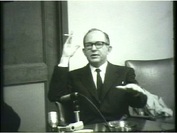
Immediate Reactions
"There were those who said this is an old injustice, and there is no need to hurry...There were those who said smaller and more gradual measures should be tried...There were those who said that this is a many-sided and very complex problem. But however viewed, the denial of the right to vote is still a deadly wrong."
- President Lyndon Baines Johnson, Remarks in the Capitol Rotunda at the Signing of the Voting Rights Act, August 6, 1965
- President Lyndon Baines Johnson, Remarks in the Capitol Rotunda at the Signing of the Voting Rights Act, August 6, 1965
While black leaders hailed the act, southern states resented federal interference in voting matters; they considered this an egregious overreach of federal powers.
Supreme Court Upholds VRA
South Carolina v. Katzenbach (1966)
"Question:
Did the [Voting Rights] Act violate the states' rights to implement and control elections?
Conclusion
The Court upheld the law. Noting that the enforcement clause of the Fifteenth Amendment gave Congress "full remedial powers" to prevent racial discrimination in voting, the Act was a "legitimate response" to the "insidious and pervasive evil" which had denied blacks the right to vote since the Fifteenth Amendment's adoption in 1870."
- OYEZ, South Carolina v. Katzenbach
Did the [Voting Rights] Act violate the states' rights to implement and control elections?
Conclusion
The Court upheld the law. Noting that the enforcement clause of the Fifteenth Amendment gave Congress "full remedial powers" to prevent racial discrimination in voting, the Act was a "legitimate response" to the "insidious and pervasive evil" which had denied blacks the right to vote since the Fifteenth Amendment's adoption in 1870."
- OYEZ, South Carolina v. Katzenbach
Proponents
"The voting rights act and the struggle to gain it in the South was indeed a turning point...That act empowered more than black people. The country is in fact more democratic (small d.)"
- Email Interview, Charles Cobb, Former field secretary, Student Nonviolent Coordinating Committee, December 2012
- Email Interview, Charles Cobb, Former field secretary, Student Nonviolent Coordinating Committee, December 2012
 |
 |
 |
|
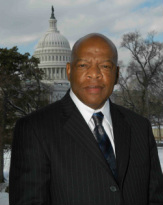
"That day was a culmination, a climax, the end of a very long road...In a sense, it represented a high point in modern America, probably the finest hour in terms of civil rights."
|
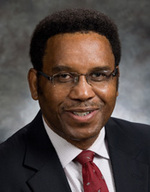
"Before the year was over, a quarter of a million, black people had been registered to vote.... and the next year, the voter turnout, in states like Mississippi, Louisiana Alabama, and Tennessee, had more than doubled."
|
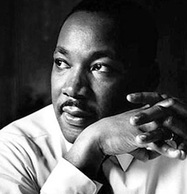
"We know that by qualification alone, there will be Negro policemen...state legislators, congressmen, governors, senators, and some day a Negro President of the United States."
|
|
- Congressman John Lewis, SNCC leader and Selma marcher, Walking with the Wind: A Memoir of the Movement.
|
- Dr. Richard Bailey, Black History Historian, Part 10- The Passage of the 1965 Voting Rights Act
|
- Dr. Martin Luther King Jr., after the signing of Voting Rights Act of 1965
|
Opponents
"The Chief Justice himself was the verbal target of the ultra conservative faction across the nation, who clamored for his removal from office because of the Supreme Court's liberal decisions on civil rights."
- Texas Politics in My Rear View Mirror by Waggoner Carr, Attorney General, Texas
- Texas Politics in My Rear View Mirror by Waggoner Carr, Attorney General, Texas
 |
 |
 |
|
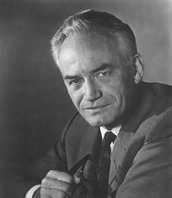
"Mr. Goldwater who had objected to the 1964 Civil Rights Act on the constitutional grounds, said the 1965 voting rights bill was both unconstitutional and unnecessary."
|
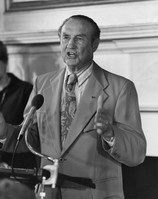
"Sen. Strom Thurmond called the proposed voting laws an "attempted power grab" by the President and
Congress." |
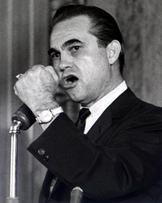
"His [Wallace's] campaign slogan was 'Vote right, vote white."
|
|
- Senator Barry Goldwater (Republican), April 2, 1965, The New York Times
|
- Senator Strom Thrumond (Democrat turned Republican), March 22, 1965, The News and Courier, LBJ Presidential Library
|
- Governor George Wallace (Democrat), The Journal of Blacks in Higher Education
No. 14 (Winter, 1996-1997), pp. 67-68 |
|
|
|
|
|